
   |

One Of These Nights
Eagles
Asylum 1039
Released: June 1975
Chart Peak: #1
Weeks Charted: 56
Certified Gold: 6/30/75
 The Eagles' fourth album represents the apex of post-Byrds Southern California rock. Their music reflects the Hollywood ethos of glamorous, narcissistic ennui, exhibiting the contradiction between the city's atmosphere of "laid-back" machismo and its desperate rootlessness of spirit. Even the Eagles' more plaintive songs have a surface sweetness that belies the jaded pessimism of so many of their lyrics. This sweetness, combined with superb arrangements, brilliant playing and the seamless vocal harmonies of Glenn Frey, Don Henley and Randy Meisner, accounts for the band's popularity, for it evokes everything gratifying that people would like to fantasize about L.A.
Unlike their previous three albums, One of These Nights is not self-consciously structured around contemporary myths. Though I found the semioperatic Desperado, which likened rock stars to outlaws, an intelligent concept, it also struck me as glibly self-satisfied. Likewise, On the Border's tributes to James Dean and Gram Parsons, while they conveyed vigor and pathos, showed no strong feeling of either violence or grief. A major reason I like One of These Nights more than its forerunners is its relative lack of conceptual pretension. The best songs portray L.A. culture fairly straightforwardly, using occult eroticism ("One of These Nights," "Too Many Hands" and "Visions") and sexual duplicity and malaise ("Hollywood Waltz," "Lyin' Eyes," "After the Thrill Is Gone") as metaphors for the city's transient, hedonistic ambience.
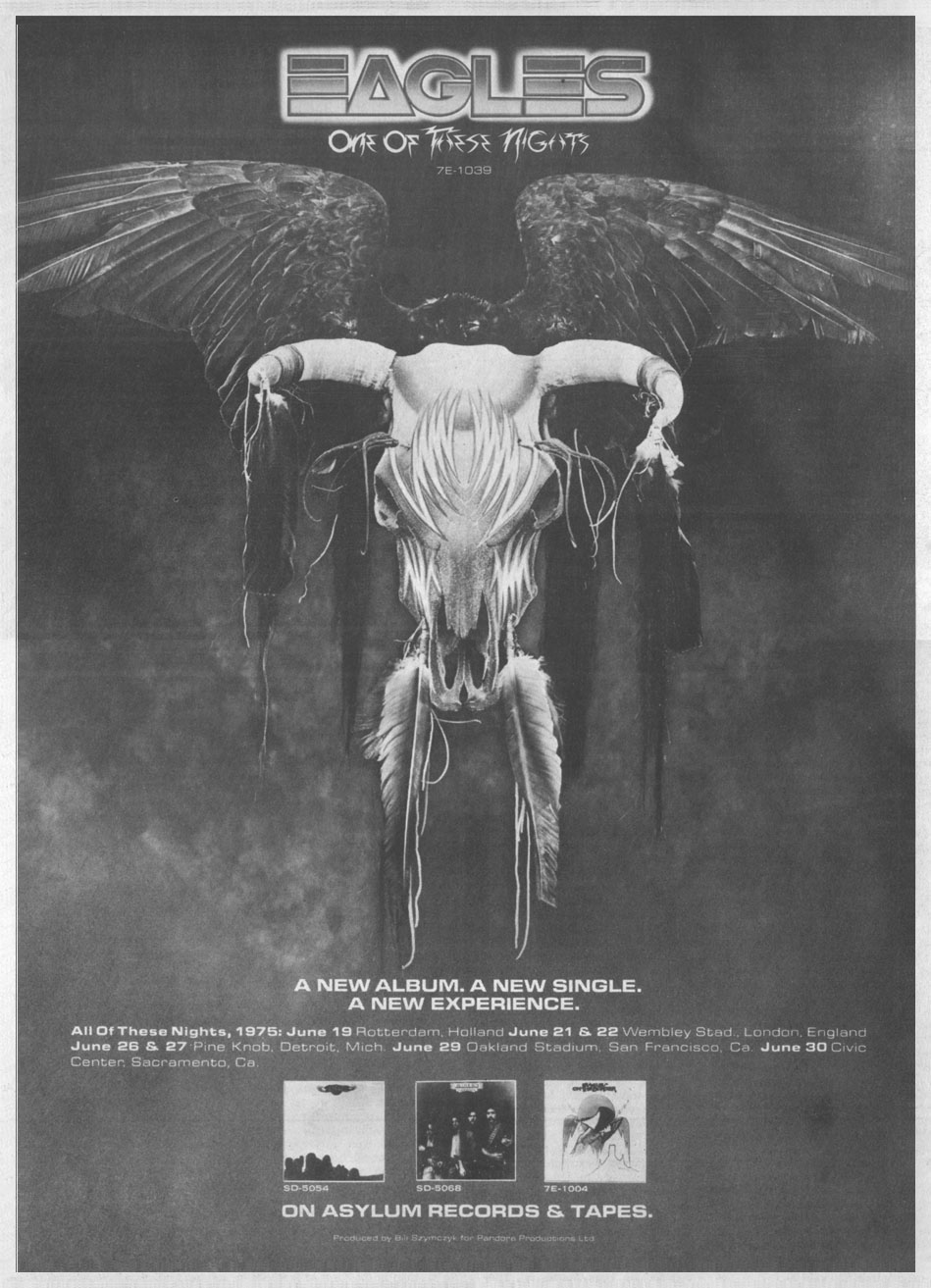 Click image for larger view. |
- Stephen Holden, Rolling Stone, 8/14/74.
Bonus Reviews!
As far as I'm concerned, country-rock has proved to be a total dead end. When the fusion really worked, as it did in the dazzling surface textures of certain track by the Lovin' Spoonful, Moby Grape, the Youngbloods, the Byrds, the Allman Brothers in their "Blue Sky" moments, or even the roughhewn (and slightly mad) best work of the Burrito Brothers and the late Gram Parsons, it was one of the most appealing of all the rock hybrids. Unfortunately, what it has boiled down to of late is usually an adenoidal kid from the Bronx pretending to be a redneck while singing mawkish nonsense to the accompaniment of a steel guitar. You all know who I mean: Poco, with their infuriatingly moronic grinning optimism; the unspeakably banal Souther-Hillman-Furay Band; Loggins and Messina... the list is endless. And while I'm on the subject, the Cosmic Cowboy fantasy these groups purvey is, as far as I'm concerned, fully as boring and corny as all that sci-fi/pseudodecadent androgyny offered by the glitter contingent.
Which may be why I'm so disappointed in the Eagles; they seemed at first to promise so much more. When "Take It Easy" blasted onto the airwaves in the summer of 1972, it was so obviously a major record that one naturally assumed this was a group to be reckoned with. It was perfect: a real fusion song that didn't compromise either of the forms it was working with, complete with bracing harmonies, a charming lyric, powerful Who-esque playing and production, and an arrangement that built from start to finish. A classic by any standards.
Needless to say, nothing they've done since has come even close to that one magnificent moment. The first album was totally forgettable (except that "Witchy Woman" sounded like an unconscious parody of the score for a John Ford western at just the point are massing on the horizon); "Desperado" was an unqualified dud (do you really care if you ever hear "Tequila Sunrise" again?); and the third album... well, "Already Gone" was good enough to be a hit, but any competent band could have made a rocker like that, "Best of My Love" is so soppy that I rate it my major AM annoyance so far this year, and as for the rest, despite the opinions of various friends whose opinions I respect, the mere thought of having to listen to their version of Tom Waits' similarly execrable and sentimental "Old '55" is bound to make me break out in hives.
And the new one? You guessed it... the same old same old. You can predict every lick, every other lyric line, and there are two really horrendous bummers -- a six-minute exercise in old-style psychedelia in which Bernie Leadon's banjo does a ridiculous sitar imitation ("Journey of the Sorcerer"), and what may be the world's first c-&-w cocktail song, "I Wish You Peace." In fairness, I must also point out that there are two bits I like a little, and the end of "Hollywood Waltz" attains some real tinselly grandeur as the instrumentation builds up relentlessly.
I can't explain why the group hasn't done any better than they have. Glenn Frey has a terrific rock voice, whether he's faking a country twang or not, the rest of them are great harmony singers, and instrumentally they're as proficient as any band in the world. My suspicion is, simply, that the genre itself is played out. Rock, as we know, is all about the endless manipulation of the cliché, and I'm reasonably certain that unless there's some genius out there we don't know about yet, none of the country-rock clichés are going to be manipulated very interestingly in the foreseeable future. They certainly aren't on One of These Nights. More's the pity.
- Steve Simels, Stereo Review, 8/75.
An absolutely stunning album and the ultimate distillation of the Eagles style, satin-smooth vocal harmonies blending effortlessly into tight and exciting guitar jams. There's a relaxed, flowing beauty throughout the cuts that the Eagles have never quite achieved at this level before. Best cuts: "One Of These Nights," "Too Many Hands," "Lyin' Eyes," "Take It To The Limit."
- Billboard, 1974.
The Eagles' breakthrough album, a convincing mix of heady rockers and lush ballads, featuring the Top Ten hits "One Of These Nights," "Lyin' Eyes," and "Take It to the Limit." * * *
- William Ruhlmann, The All-Music Guide to Rock, 1995.
One of These Nights is the apex of the Eagles' twang time with some truly gorgeous moments in "Lyin' Eyes" and "Take it to the Limit." * * *
- Gary Graff, Musichound Rock: The Essential Album Guide, 1996.
With its pin-sharp production sound and slickly crafted songs, the Eagles' fourth album, One Of These Nights, was the band's first US Number One album and thanks to the title track gave the band their second Number One single in the US, in July 1975, after the previous year's "Best Of My Love," plus two more hit singles on both sides of the Atlantic. At the year's end, Bernie Leadon left the band and was replaced by Joe Walsh.
The band's wonderful harmonies are once again in evidence, particularly on the title song, while their story-telling talents are given the full treatment on the achingly bittersweet "Lyin' Eyes" (a Grammy Award winner) -- a Number 23 in the UK, as well as a Grammy winner in 1976 -- and "After The Thrill Is Gone." "Take It To The Limit" reached Number Four on the singles' chart in the US and Number 12 in the UK.
"Too Many Hands" and "Visions" are a couple of rousing rockers, while "Hollywood Waltz" is a classic Eagles' ballad. Fans of the UK TV show Hitchhiker's Guide To The Galaxy will meanwhile recognize the album's one instrumental, "Journey Of The Sorceror," as the source for the programme's musical theme.
The album topped the US Hot 100 and reached Number Eight on the UK album chart.
As of 2004, One Of These Nights was the #58 best-selling album of the 70s.
- Hamish Champ, The 100 Best-Selling Albums of the 70s, 2004.
 Reader's Comments
No comments so far, be the first to comment.
 Buying Options





