
   |

Laid Back
Gregg Allman
Capricorn 0116
Released: October 1973
Chart Peak: #13
Weeks Charted: 39
Certified Gold: 3/5/74
 This album has been in the works for some time and was almost completed when work began on Brothers And Sisters. Several sessions with noted musicians weren't used, but it was through his keyboard work on these tracks that Chuck Leavell was asked to join the Brothers Band. The operative word is production -- lots of horns and strings (46 pieces on one cut, and a 14-voice chorus). Gregg seems content to concentrate on vocals; organ is heard on only a few cuts and mostly as fill, rather than lead instrument.
There are two remakes of Brothers tunes, both originally from the Idlewild South album. "Midnight Rider" gets a more classic, almost ghostlike gothic treatment. The opening repetitive guitar figure is joined by piano and dobro which weave in and out, drone-like. Gregg's vocal has just the right desperado touch, although you might miss the original harmonies at first. The strings and horns that swoop in and out add a final and pervasive depth the first version doesn't have. On "Please Call Home," the arrangement is substantially the same, with a chorus added, but Gregg's vocal is a good deal less raspy and more effective here.
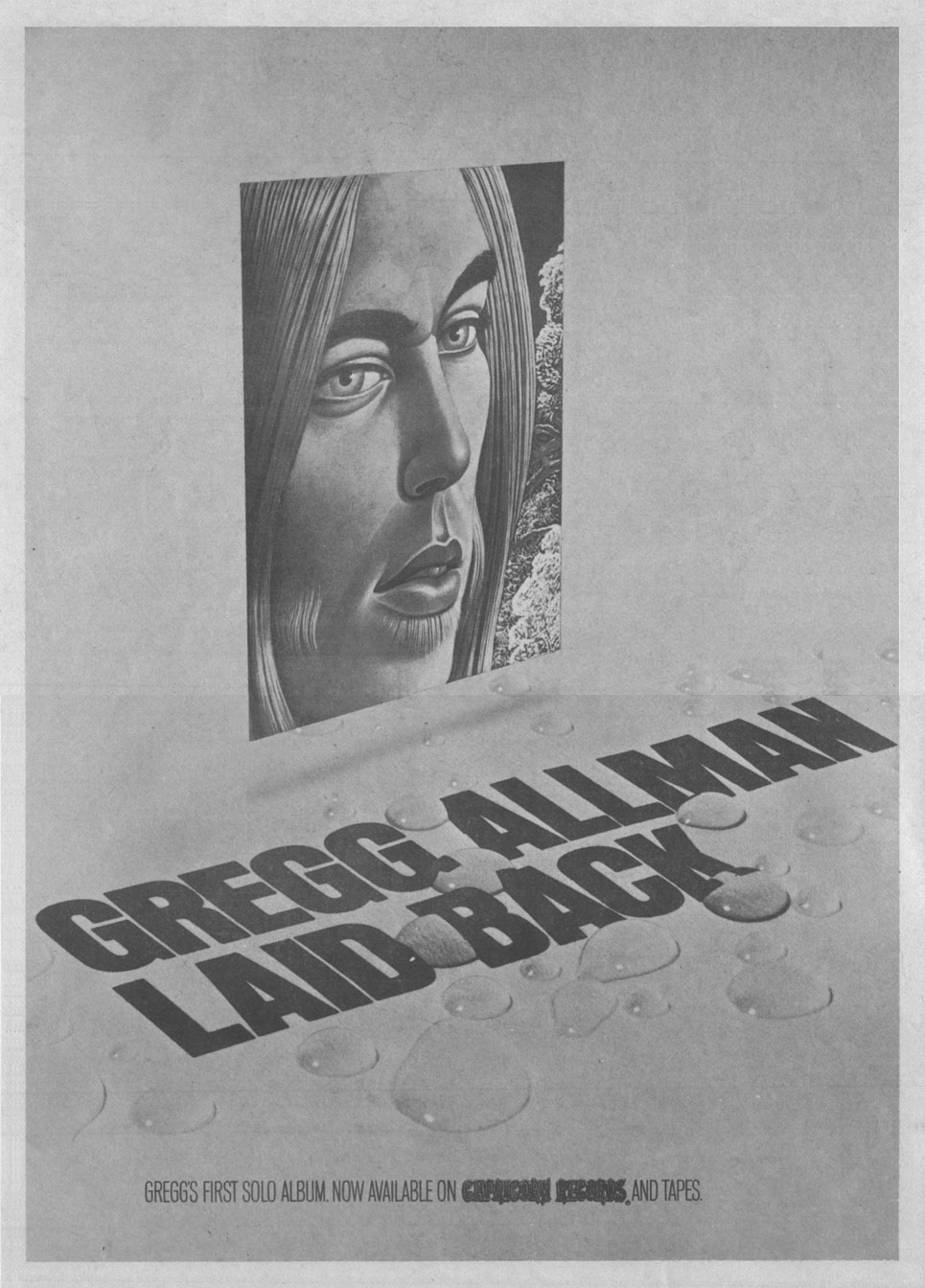 Click image for larger view. |
The only real up song is the late Fifties, Fontella Bass-Bobby McClure "Don't Mess Up a Good Thing." There's a nice smooth sax break by David Newman, and good piano work by Leavell; the female chorus trades lines with Gregg, and the cut jumps.
There are two newer songs by Gregg as well. "Queen Of Hearts" is a reflective love song with a feeling for autumn sundowns. It's the only track where guitar plays a leading role, and the flowering sax ride on the break by Newman expands the whole song into an easy rocking jazz groove. "Multi Colored Lady" seems to be many listeners' favorite with the narrative painting a picture of a crying lady on a late night bus ride. A really nice, spacy and evocative cut, and the only one where love doesn't hurt. Yet.
The album closes with the traditional "Will the Circle Be Unbroken," given full gospel honors. The melody line is one that kept showing up in the long jams when Duane was playing with the Brothers, and this version holds him strongly in mind. Though there's a strong piano drive, it has a quiet dignity and stateliness missing in most of the more raucous recent versions. Over a solid vocal chorus, Gregg really tries to close the circle.
Laid Back isn't quite what you'd expect from Gregg's work with the Brothers Band. Instead, it's a moody LP, often tinged with grandeur, and maybe just a little too rich and one-colored in spots. But on the whole, a moving look at another side of a finely charismatic singer/writer.
- Tony Glover, Rolling Stone, 1-3-74.
 Further reading on Super Seventies RockSite!: Album Review: Article: 'What I've Learned' |
Each time I hear this album I am more grateful for it. In fact, if Gregg Allman ever made a public statement that the earth is flat, I would be willing to give it serious consideration. Here is one of those rare singers whose voice can aptly be called an instrument; any guitarist, trumpeter, pianist, or saxophonist would be proud to invent embellishments and improvisations on tunes the way Allman does. Most of the tunes here are taken at slow tempos, yet he manages to inject syncopation into his vocals, a wondrously effective technique. But there's nothing studied here, just soul.
Allman keeps reminding us that in loneliness there is a strange kind of comfort. The twilight wail in his voice seems to summon up every lonely Scots-Irish ghost from his Southern ancestry that ever went looking for a friend. His music is real Southern matrix-music. The mesh of Allman and his supporting players is perfect, too. There isn't one thing wrong with this album.
- Joel Vance, Stereo Review, 3/74.
A masterpiece of a set from an underrated member of one of the nation's top bands, featuring exceptional displays of vocal and instrumental talent in many musical areas. A reworked, haunting version of Gregg's by now almost standard "Midnight Rider" is better than the original, while the beautiful Jackson Browne cut, "These Days," gets as fine an interpretation as has ever been rendered, with AlIman's voice showing striking sensitivity. The topper is "Will The Circle Be Unbroken?" with its beautiful gospel feel, fine vocals, near-perfect backup vocals, and building instrumentals. One of the few LP's able to rival the AlIman's own Brothers and Sisters.
- Billboard, 1973.
Gregg still doesn't know the difference between drawling slowly and singing soulfully, and it isn't tragedy that makes him sound so doleful, it's a limited formal imagination. That said, it must be admitted that he puts a lot into "These Days" and "Midnight Rider," and that the reason you can listen to such originals as "Please Call Home" and "Multicolored Lady" isn't the writing. B
- Robert Christgau, Christgau's Record Guide, 1981.
Wracked by tragedy and treachery, the Allman Brothers Band disintegrated in the early Seventies. This was Gregg's first recording following that break-up. It's an excellent southern blues/rock album, which rightfully focuses on Allman's laid-back but affecting vocals. While the overall quality of the material is pretty good, the standouts, "Midnight Rider," Jackson Browne's "These Days," and "Multi-Colored Lady," are exceptional. The CD's sound is very clean, with nice vocal definition and placement, and is a clear improvement over the LP. B
- Bill Shapiro, Rock & Roll Review: A Guide to Good Rock on CD, 1991.
His debut solo album showcases Allman's soulful, earthy keyboard work and leathery drawl to good effect. "These Days" and the reworked Allman Brothers Band standard "Midnight Rider" are exceptional. * * * *
- Rick Clark, The All-Music Guide to Rock, 1995.
 Reader's Comments
David Fogleman
Who is the girl on the horse on the centerfold of Laid Back?
 Buying Options





